On this page
There are three different answers to “are these tyres finished”, and they do not agree with each other. One is what the tyre itself tells you, one is what your state will fine you for, and one is how the tyre behaves in the rain. Knowing which is which stops you replacing tyres a year early, and stops you driving on them a winter too long.
Key figures
- 1.6 mm Depth where federal tire wear indicators appear
- 1/32 inch California minimum tread for ordinary passenger vehicles
The wear bars are set at 1/16 of an inch
Federal motor vehicle safety standards require passenger car tyres to carry a tread wear indicator: raised bars across the bottom of the grooves that become flush with the surrounding tread when the tyre has worn to 1.6 mm, which the regulation writes as 1/16 of an inch. That is the same depth the tyre trade calls 2/32.
When the bars are flush with the tread, the tyre has reached the point the standard was written around. It is a manufacturing requirement rather than advice about your driving, and it is the clearest signal the tyre gives you without a gauge.
The legal minimum is a state question
There is no single federal tread depth for passenger cars in normal use. Each state sets its own, and they differ more than most drivers expect.
| Rule | Depth | Applies to |
|---|---|---|
| Federal tyre standard wear bars | 1.6 mm (1/16 inch, 2/32) | The indicator moulded into new passenger tyres |
| Federal rules for commercial vehicles | 4/32 inch | Front wheels of a bus, truck or truck tractor |
| Federal rules for commercial vehicles | 2/32 inch | All other positions on those vehicles |
| California Vehicle Code | 1/32 inch | Ordinary passenger vehicles |
The California figure is worth sitting with. The state’s limit for a car is half the depth at which the tyre’s own wear indicator appears. Legal and safe are not the same test, and the federal commercial rule, which demands twice the tread on a steering axle, shows which way the safety argument runs.
Measure across the tyre, not at one point
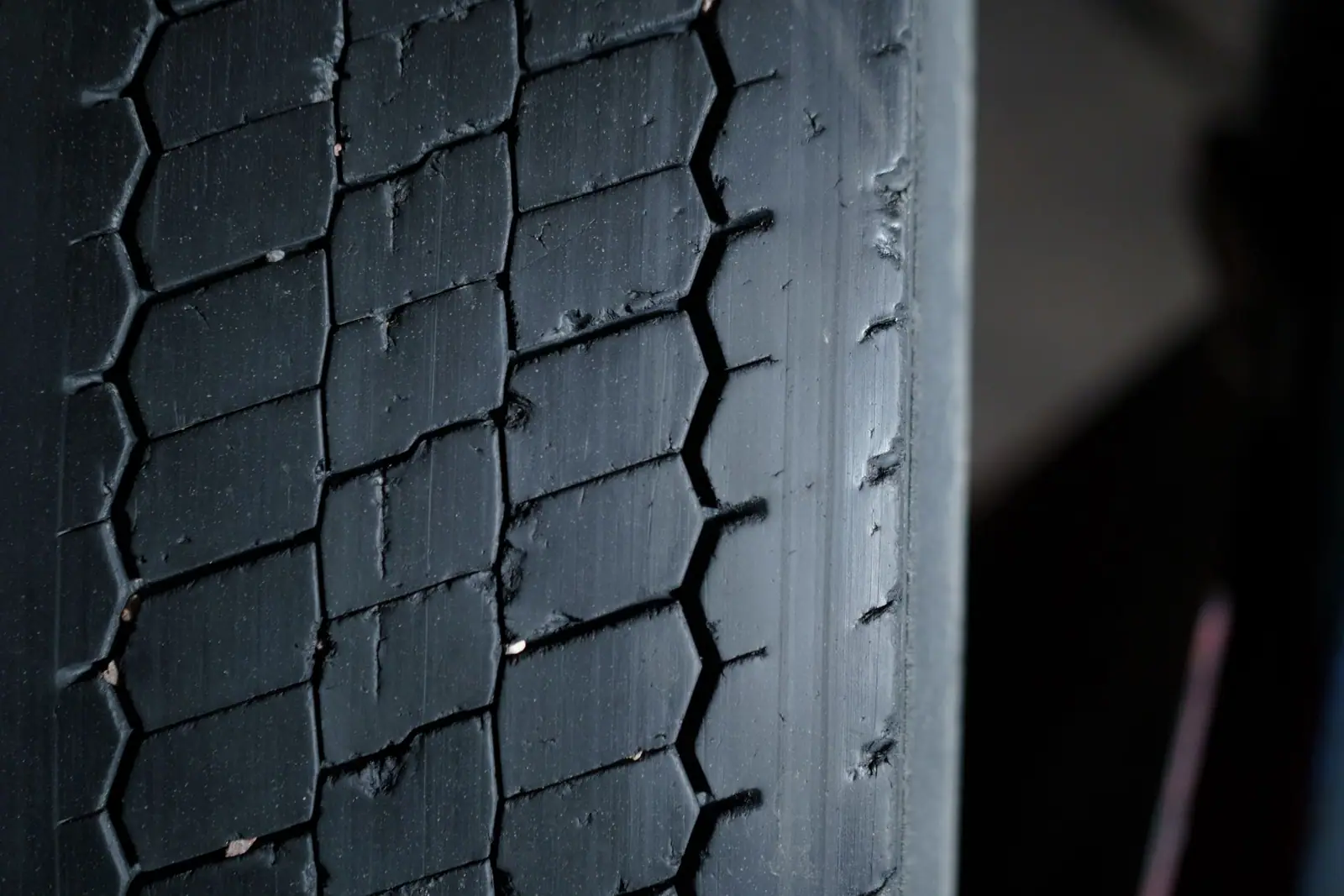
Check the depth in several grooves and at the inner, middle and outer parts of the tread. Uneven wear is diagnostic:
- Both edges worn, centre fine: chronic under-inflation.
- Centre worn, edges fine: chronic over-inflation.
- One edge only: alignment, usually camber or toe.
- Patchy or scalloped: worn suspension components, or wheels out of balance.
Replacing tyres without fixing the cause buys you the same wear pattern again. If one edge is gone, get the alignment checked before fitting new tyres, not after.
Age matters even when the tread does not
Rubber ages whether the car moves or not, and a tyre with plenty of tread can be too old to trust. Every tyre sold in the United States carries a Tire Identification Number moulded into the sidewall, and federal rules define the format: the date code is four digits at the end, the first two giving the week of the year and the last two the year. The regulation’s own example is 0109, meaning the first full week of 2009.
Check it on a used car, on the spare, and on any tyre that has been on a trailer or a second vehicle for years. A car with 20,000 miles on it and eleven-year-old tyres is on original rubber that is past its useful life, whatever the tread looks like.
The spare is the tyre nobody inspects. If it is a full-size spare it is ageing at the same rate as the others; if it is a temporary spare it has a speed and distance limit printed on it. Check the pressure and the date code once a year, at the same time as everything else.
Pressure is where the money is
Under-inflation costs fuel, wears the shoulders and runs the tyre hot. The EPA and the Department of Energy put the fuel effect at about 0.6 percent on average and up to 3 percent, with roughly 0.2 percent lost for every 1 psi the tyres are down.
Three practical points:
- The correct pressure is on the door jamb placard, not on the tyre sidewall. The sidewall figure is the maximum the tyre can hold, not what your car wants.
- Check them cold, before driving or at least three hours after. Warm tyres read high.
- The warning light comes on late. Tyre pressure monitoring systems are designed to warn you about a significantly under-inflated tyre, not to keep pressures optimal. A tyre can be several psi low with no light showing.
When to replace
- The wear bars are flush with the tread anywhere on the tyre.
- The tread is uneven enough that part of the tyre is finished even if the rest is not.
- There is a bulge in the sidewall, a cut deep enough to reach the belts, or a puncture in the shoulder rather than the centre.
- The tyres are old enough that the rubber is hard and the sidewalls show fine cracking.
- You drive in rain or snow regularly and the depth is getting close to the bars. Water has to go somewhere, and it goes into the grooves.
If a tire has a puncture, the repair-or-replacement guide addresses damage separately from tread wear. The wheel-alignment comparison explains when uneven wear warrants another diagnosis.
Questions people ask
What tread depth means a tyre is worn out?
Federal tyre standards require wear indicators that appear when the tread reaches 1.6 mm, written in the regulation as 1/16 of an inch and known in the trade as 2/32. When those bars are flush with the tread, the tyre has reached that point.
Is the penny test accurate?
It is a rough check. A US penny inserted head down shows roughly 2/32 of an inch when the top of Lincoln's head stays visible, which is about the depth of the wear bars. A tread depth gauge costs a few dollars and removes the guesswork, especially for checking wear across the tyre.
How old is too old for a tyre?
There is no federal age limit for passenger tyres, so read the date code and use judgement: the last four digits of the DOT number give the week and year of manufacture. Rubber hardens and cracks with age, so a tyre with deep tread can still be past its useful life.
Does tyre pressure really affect fuel economy?
Yes, though modestly. The EPA and DOE put it at about 0.6 percent on average and up to 3 percent, with roughly 0.2 percent lost per psi of under-inflation. The larger effects of low pressure are uneven wear and heat build-up.
Where these figures come from
- 49 CFR 571.109, Standard No. 109, New pneumatic and certain specialty tires Electronic Code of Federal Regulations · ecfr.gov
- 49 CFR 393.75, Tires Electronic Code of Federal Regulations · ecfr.gov
- 49 CFR 574.5, Tire identification requirements Electronic Code of Federal Regulations · ecfr.gov
- California Vehicle Code section 27465 California Legislative Information · leginfo.legislature.ca.gov
- Keeping Your Vehicle in Shape US Department of Energy and EPA, fueleconomy.gov · fueleconomy.gov
Figures last checked September 2026.