On this page
A toll transponder can have a purchase price, a refundable deposit and money loaded for future tolls. Those amounts affect the opening cash requirement in different ways. Calling every dollar loaded into an account a fee overstates the device’s cost; calling that balance a saving understates the tolls the driver will still pay.
The October 2026 examples below use SunPass, Bay Area FasTrak and the Golden Gate Bridge’s own current schedules. They describe different issuers and facilities, rather than one nationwide pass. Compare compatibility and the route’s toll rate before buying, and keep the account’s funding separate from the expense incurred at each crossing.
Key figures
- $4.99 SunPass Mini device, before tax
- $14.95 SunPass PRO device, before tax
- $10 SunPass initial prepaid toll balance
SunPass charges $4.99 or $14.95 for the device
SunPass lists its Mini sticker at $4.99 plus tax and portable PRO at $14.95 plus tax. Its account FAQ specifies a minimum $10 replenishment on activation. That means the initial pre-tax cash outlay is $14.99 for Mini or $24.95 for PRO when combined with the stated minimum funding.
| SunPass example | Device purchase | Minimum activation funding | Pre-tax initial cash |
|---|---|---|---|
| Mini sticker | $4.99 | $10 | $14.99 |
| PRO portable | $14.95 | $10 | $24.95 |
Source note: SunPass’s first-party FAQ, checked October 2026. Funding becomes prepaid toll balance; it is not another device fee. Totals exclude tax on the purchase and later replenishments.
The device-price difference is $9.96. Choose between them by the routes, transfer needs and compatibility requirements rather than assuming the expensive model gives a larger discount at every toll point. The Mini sticker does not work after removal; a portable device offers a different arrangement when the driver changes vehicles.
The car-ownership budget guide keeps recurring toll use visible. The equipment can be inexpensive while a frequent commute creates a substantial monthly road charge.
A prepaid balance is funding, while a deposit can be refundable
Bay Area FasTrak’s tag FAQ describes the tag as loaned equipment. For a single tag with credit-card automatic replenishment, its table lists a $25 opening prepaid balance and no security deposit. The manual-replenishment example adds a $5 refundable deposit, bringing opening cash to $30.
That is different from purchasing a $25 device. The prepaid amount pays future tolls, while the deposit’s refund depends on account closure and returning the tag in good condition under the issuer’s terms. Lost or damaged equipment can change the refund outcome. Different FasTrak issuers can have different accounts, so do not extend the Bay Area table to every California program.
Suppose a driver loads an assumed $50 and then incurs $18 in tolls. The resulting prepaid balance is $32 before other transactions. The spending is $18, not $68. Adding the loading payment to the same tolls as a second expense double-counts the money as it moves into and out of the account.
Auto-replenishment also means the next card charge can exceed the toll expense for the same period. Review the statement’s opening balance, replenishments, tolls, fees and closing balance when reconciling the budget. The card transaction is a funding movement, not necessarily the amount of road use that month.
The Golden Gate’s own schedule gives a $1 invoice difference
The Golden Gate Bridge’s schedule effective July 1, 2026 lists $10.25 for a two-axle vehicle or motorcycle using FasTrak, $10.50 for a license-plate account or one-time payment, and $11.25 by invoice. Tolls are charged southbound into San Francisco. These facility rates should be read from the bridge operator, because a general regional summary can lag behind its current table.
| Golden Gate two-axle payment method | Published toll | Twenty charged crossings, calculated |
|---|---|---|
| FasTrak | $10.25 | $205 |
| Plate account or one-time payment | $10.50 | $210 |
| Invoice | $11.25 | $225 |
Source note: Golden Gate Bridge, Highway and Transportation District toll schedule effective July 1, 2026. Twenty crossings are an assumed usage example, not a commuter plan; other axle classes and eligible carpools have different rates.
- FasTrak$10.25
- Plate account or one-time payment$10.50
- Invoice$11.25
Source note: Golden Gate Bridge, Highway and Transportation District toll schedule effective July 1, 2026. Twenty crossings are an assumed usage example, not a commuter plan; other axle classes and eligible carpools have different rates.
FasTrak is $1 less than invoice payment per charged crossing and $0.25 less than a plate account. For twenty, the differences are $20 and $5. A round trip across the same bridge should not automatically be counted as two charges when only one direction is tolled.
Do not claim the SunPass purchase in the first table earns this California discount. The examples describe different systems. Compatibility must be established for the road the driver uses, and owning an electronic pass from another region does not make it accepted everywhere.

Compatibility and account settings determine the benefit
Bay Area FasTrak’s payment page distinguishes a toll tag from a license-plate account and says express lanes require a tag. A bridge payment arrangement that avoids invoices is not automatically permission to use an express lane or claim a carpool discount. Check the facility’s requirements, occupancy settings and vehicle class before the trip.
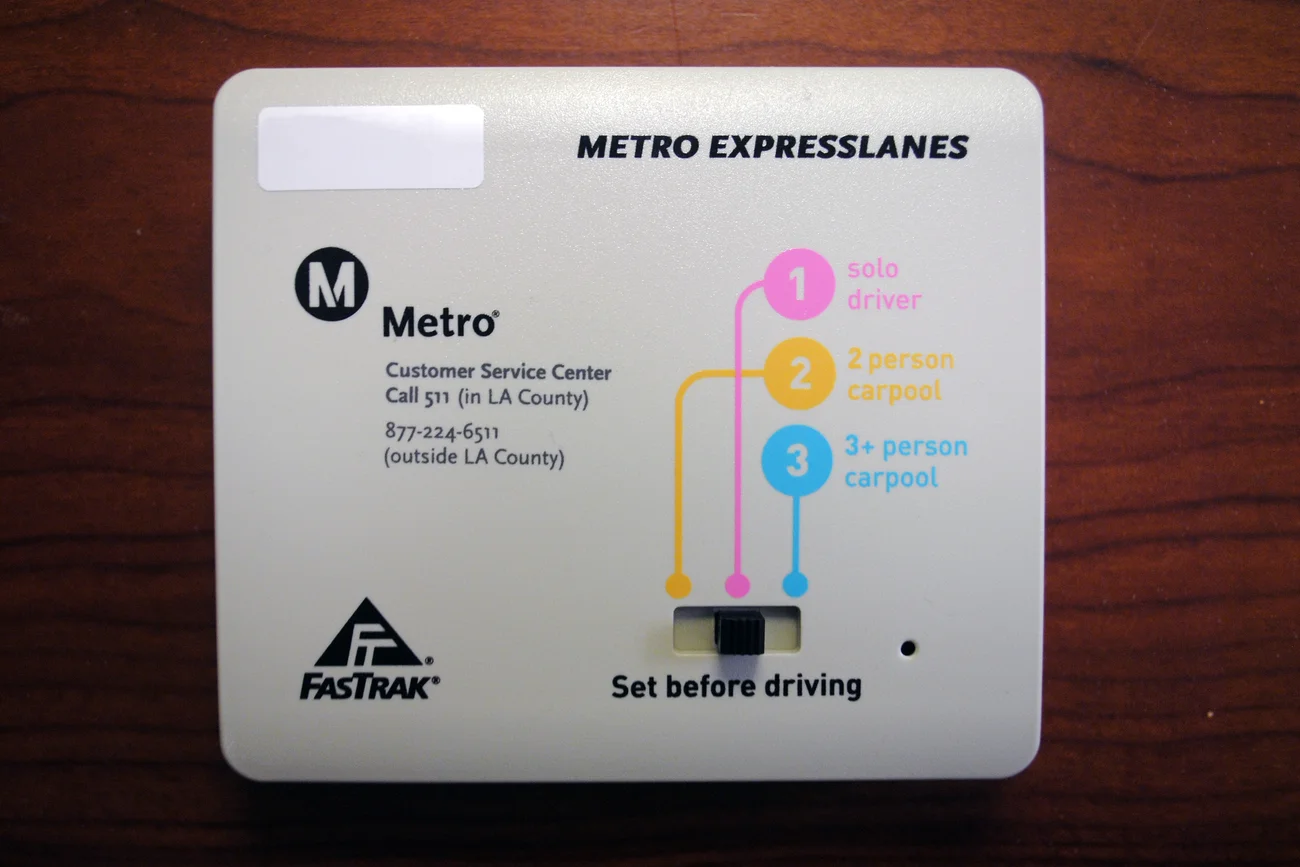
The historical Metro ExpressLanes device in the hero photograph is a switchable FasTrak example, not a photograph of a SunPass product or a promise of Bay Area account terms. The issuer, route and account rules still determine charges even when two tags share a brand name.
SunPass also cautions against multiple active transponders in one vehicle because duplicate charges can occur. Follow its mounting and shielding instructions for the equipment being carried. Record the vehicle and license plate information accurately, particularly when transferring a portable tag or disposing of a car.
The roadside-plan guide covers a separate travel expense. Neither a prepaid toll balance nor possession of a tag supplies breakdown assistance, so keep those services separate in a trip budget.
The statement reveals whether the tag is saving money
For a hypothetical pass purchase costing $15 with a verified $1 discount per charged crossing, fifteen crossings recover the purchase cost before tax and other fees. With a $0.25 difference instead, sixty are needed. These figures show break-even arithmetic; they are not a price or discount package offered by either issuer in the examples.
Compare the charged routes and vehicle class, then include any nonrefundable account fee or plan minimum. Do not count a refundable deposit as a permanent expense without its terms, and do not assume an advertised percentage saving applies to every facility. Different routes can make the same equipment more or less worthwhile.
The parking-cost guide applies the same distinction to usage and subscriptions. If a toll account can also pay participating parking facilities, those parking transactions remain expenses; the payment method does not make them included in the device price.
Check compatibility, mounting, plate information and any occupancy setting before the journey. Do not adjust account details or operate a phone while driving, and follow the facility’s posted lane instructions.
Questions people ask
Does SunPass Mini cost $14.99?
Its purchase is $4.99 plus tax. Combining that with the required minimum $10 activation funding gives $14.99 pre-tax opening cash, but the funding pays future tolls.
Is the Bay Area FasTrak $25 balance a device fee?
No. Its single-tag auto-replenishment example uses $25 as prepaid toll balance. Manual replenishment adds a refundable $5 deposit under the issuer's return terms.
How much does FasTrak save on the Golden Gate example?
The bridge's July 2026 two-axle schedule is $10.25 with FasTrak versus $11.25 by invoice or $10.50 by plate account. Twenty charged crossings differ by $20 or $5 respectively.
Will one transponder work on every toll road?
No. Verify issuer compatibility and facility rules. A bridge plate account also does not substitute for the tag required in Bay Area express lanes.
Where these figures come from
- Transponder Prices, Activation and Compatibility FAQ Florida's Turnpike Enterprise / SunPass · sunpass.com
- Toll Tag Basics: Prepaid Balance and Deposit Bay Area FasTrak · bayareafastrak.org
- Toll Schedule Effective July 1, 2026 Golden Gate Bridge, Highway and Transportation District · goldengate.org
- Ways to Pay and Express-Lane Tag Requirement Bay Area FasTrak · bayareafastrak.org
Figures last checked October 2026.